
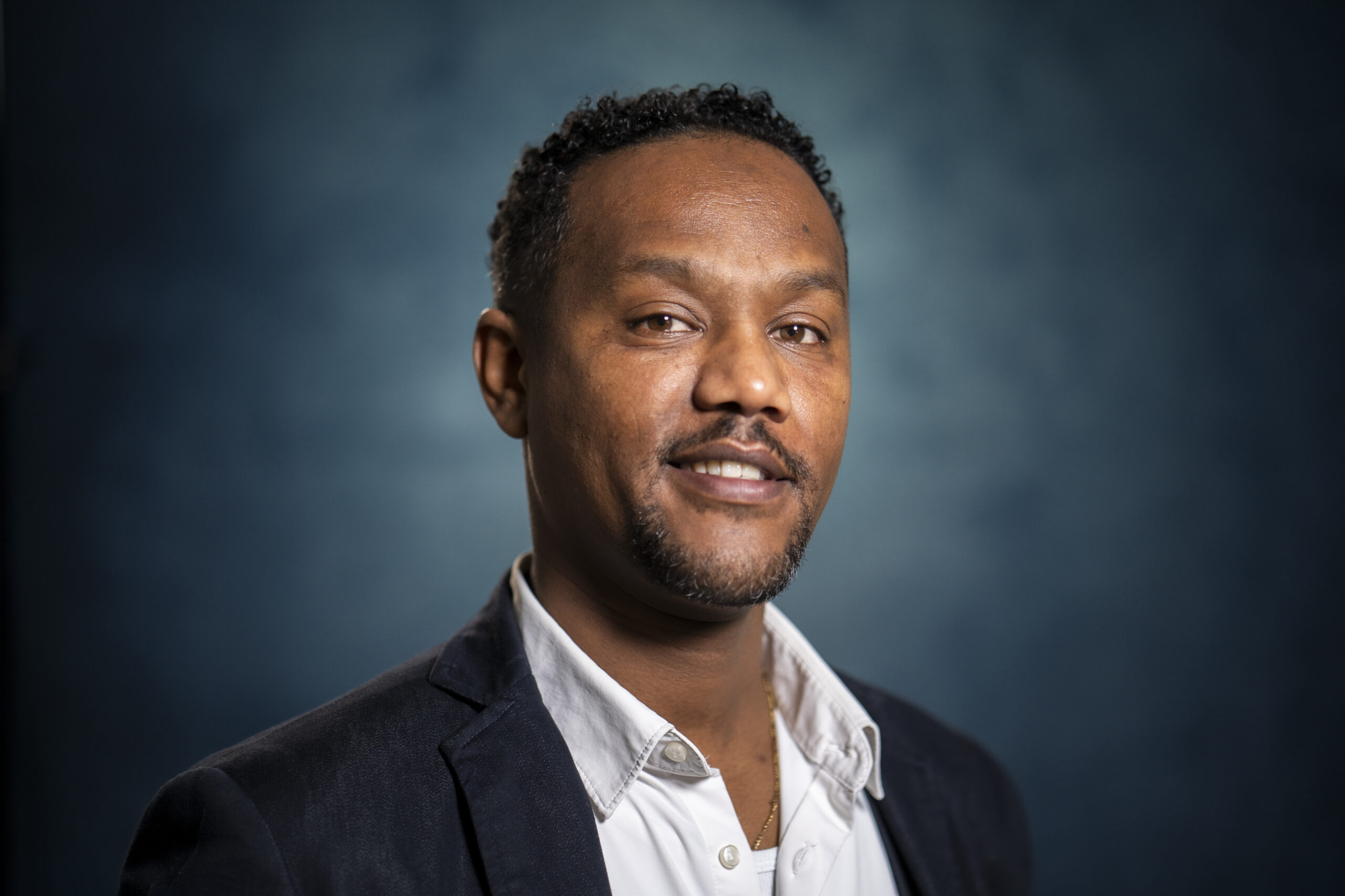
“You have to show that you’re not dangerous and that you want to belong, then everything will be fine,” says Robel from Eritrea. “Times were just bad in my country and we were at war with neighboring countries.” So he fled his country via Sudan and Libya and finally arrived in Italy in 2005. “At the time, that was the fastest way to Europe. But it wasn’t the easiest route; I traveled through forests a lot. But I was twenty years old at the time, I thought everything was normal, I wasn’t afraid.”
And so he built a life for himself in Italy. He worked as a warehouse worker and made friends. One of those friends invited him to a wedding, where he met a Dutch woman. “I came for the groom and she came for the bride. That was nice.” It was so nice that they eventually moved in together in 2017 in her hometown of Rotterdam.
From cows to different cultures
“In the past, when I thought of the Netherlands, I thought of milk, cows, and chickens,” Robel laughs. But in Rotterdam, he was surprised. “I saw an old and a new part of the city, which are really very different, but I liked that.” He was also enthusiastic about the residents. “I really enjoyed seeing how so many people from different cultures and languages live together. People here can stay true to their own culture and learn about each other’s cultures.”
He himself also stays close to his Eritrean culture, “because I am Eritrean and always will be.” He does this mainly through his faith. “I am Orthodox, so I still go to church here every week. That has now become Saturday because there is no more room on Sunday. I bring my children with me and then we eat and play together, which I enjoy.” In addition to Eritrean culture, he also feels connected to Italian culture. “Italians have a good way of life. I lived there for a long time, so I feel connected to it. I miss it too.”
The Dutch language is difficult
Robel has also embraced Dutch culture and language. “You have to integrate; that’s important. You have to show people that you’re not a threat, but that you want to be one of the people in the neighborhood. You can do that by volunteering or doing social work. The municipality can help with that.”
Still, integration wasn’t easy for Robel. “Especially because the language is so difficult. I learned Dutch with an online course. And I love learning languages; I speak about seven languages. It’s important for me to learn the language of the country where you live. Only in the Netherlands do people often speak English quickly when they see that I don’t speak Dutch very well. But then I often ask for the Dutch word, and that’s how I learned Dutch quickly. And at home, I only spoke Dutch with my wife, which also helped me a lot.”
Easy dishes
In addition to the language, he has adopted more from our culture. “The mentality of this country is open, which is different from Eritrea, and I like that. And everything is well organized here. I like that it’s easy to learn here. In this city, you can learn a lot about other cultures and eating habits.” He has learned a lot from our eating habits in particular. “In many other countries, such as Italy, you spend two or three hours in the kitchen for a five-minute meal. And in Italy, you really have to eat five courses. Here, we just eat bread for lunch, which I had never seen before! But in the end, I adopted it, because I like potatoes and meat, and it’s just easy. Like everything else here.”
Give it time
He is now used to Rotterdam, but it took some time. He advises other newcomers to give themselves that time. “At first, it can be difficult to integrate here. It’s an expensive city and it’s hard to find a place to live. But after that, once you know what to do, it gets easier. And now I know, compared to all the other cities I’ve been to and lived in, that Rotterdam is the best city.”