
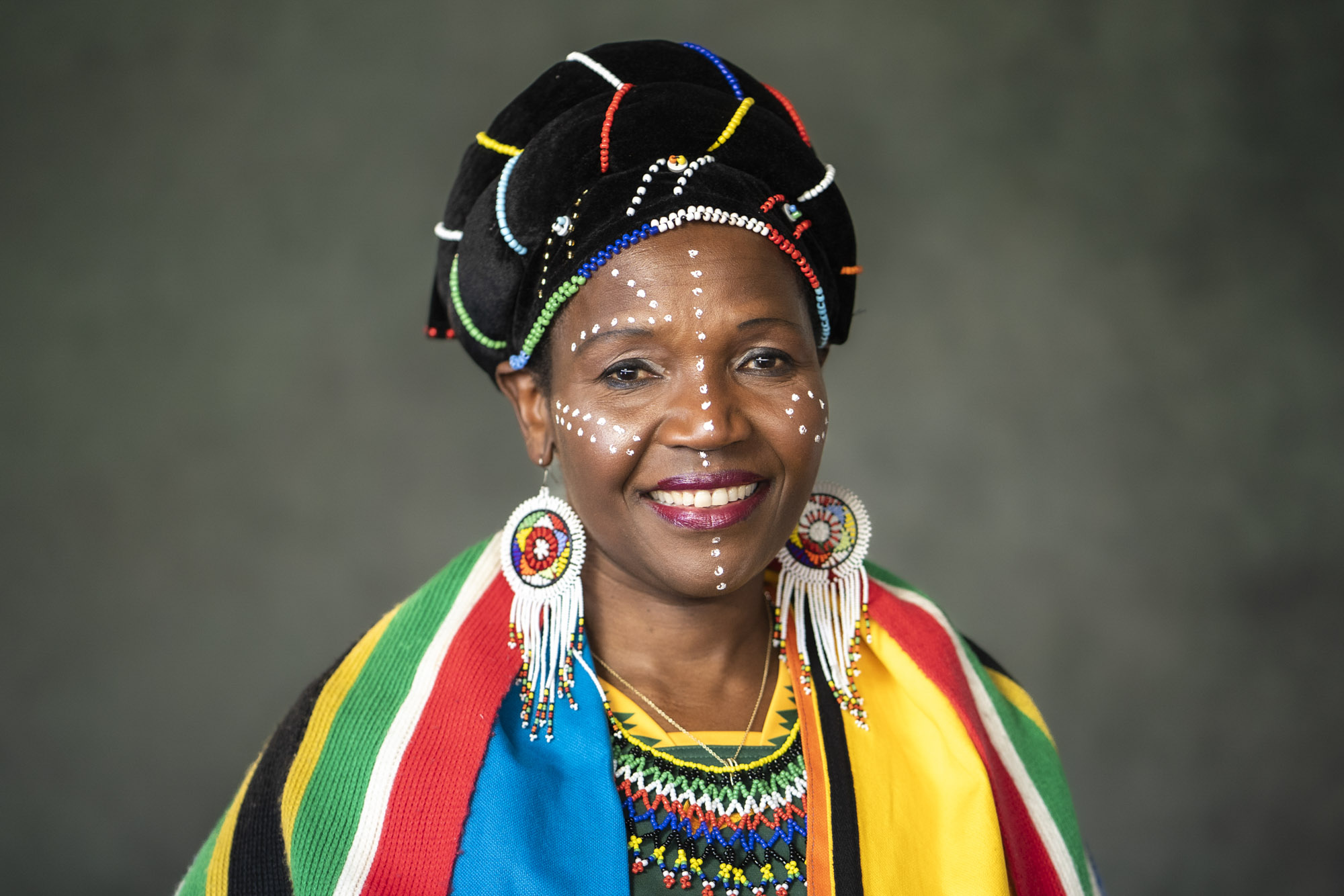
“I’m not Dutch, but South African,” says Sindiswa. She met her Dutch ex-husband when he was working in South Africa. At first, they lived together in South Africa for four years. “To see if it would work. It did, so in 1999 we decided to move to the Netherlands. Because my husband no longer had a visa to stay in South Africa.”
They ended up in Amersfoort, after which they moved to Spijkenisse. “We already had four children, so we needed a big house. And we could find a bigger house there for less money.” Unfortunately, the marriage ended there.
Raising children alone
In 2011, Sindiswa found a new home for herself and her six children in Rozenburg. There she adopted another child. The large family was not what they had planned for their life in the Netherlands as a couple. “My ex had told me a thousand times in South Africa: you live in small houses here, you don’t have large families here.” Still, she was shocked when she saw what the Netherlands was really like. “I thought: where’s the farm? The space for animals, vegetables, and fruit trees? Everything is so small. I thought: how am I going to solve this?”
Nevertheless, her desire for children and her South African sense of warmth and need for warmth were stronger, and she raised a large family. But Sindiswa notes that life in the Netherlands with a large family is difficult. “In the Netherlands, everything is strict and planned. And children are raised only by their parents. In South Africa, they belong to everyone: you can just let your children run around freely.” Others automatically take over the upbringing. Parenting is something you do together as a community. I miss that here.”
Feeling at home through language and South Africans
To feel more at home, she decided to learn Dutch. “I went to school to learn Dutch and made friends there.” She also found support among other South African women who had also moved to the Netherlands. “In South Africa, I had five other friends who were all married to Dutch men. They came to the Netherlands one by one,” she laughs. “We all did our best to feel at home, but the loneliness remained.”
She also found support at church. There she met new people who later felt like family. “I found a mother at church. I still call her mama.” This woman helped her a lot, especially with her children. And when I was having a hard time, the pastor prayed with me.“ Although Rozenburg has a church, she still goes to the one in Spijkenisse every Sunday. She also goes to the food bank there. ”I go to Rotterdam for groceries and clothing. And that’s where my children live.”
Rotterdammer
In Rotterdam, she has also learned and discovered new things. She loves the festivals, the colors, the music, and the atmosphere. “I think the Summer Carnival is great.” With the Rotterdam Pass, she discovers many activities in the city. “Then you really enjoy what Rotterdam has to offer.” She therefore feels like a Rotterdammer. “But a South African Rotterdammer,” she laughs.
She still holds on to much of her South African DNA. “For example, the warmth and cheerfulness. Everyone around me notices that. My house is always open to others. I always have food ready in the fridge,” she laughs. Music, dance, and food also play a big role. “I like to dance, I like to sing, especially in church.”
100% South African
Sindiswa has made a conscious decision not to apply for Dutch nationality. “You are born in a country and you have that nationality. I find it strange that you can move to a country and then take on that nationality. Even though I live in the Netherlands, I am South African.” And she is proud of that; it gives her a sense of identity.
Still, going back to South Africa is no longer an option for her. “My children are here, and I’m a grandmother to almost six grandchildren. They keep me here.”