
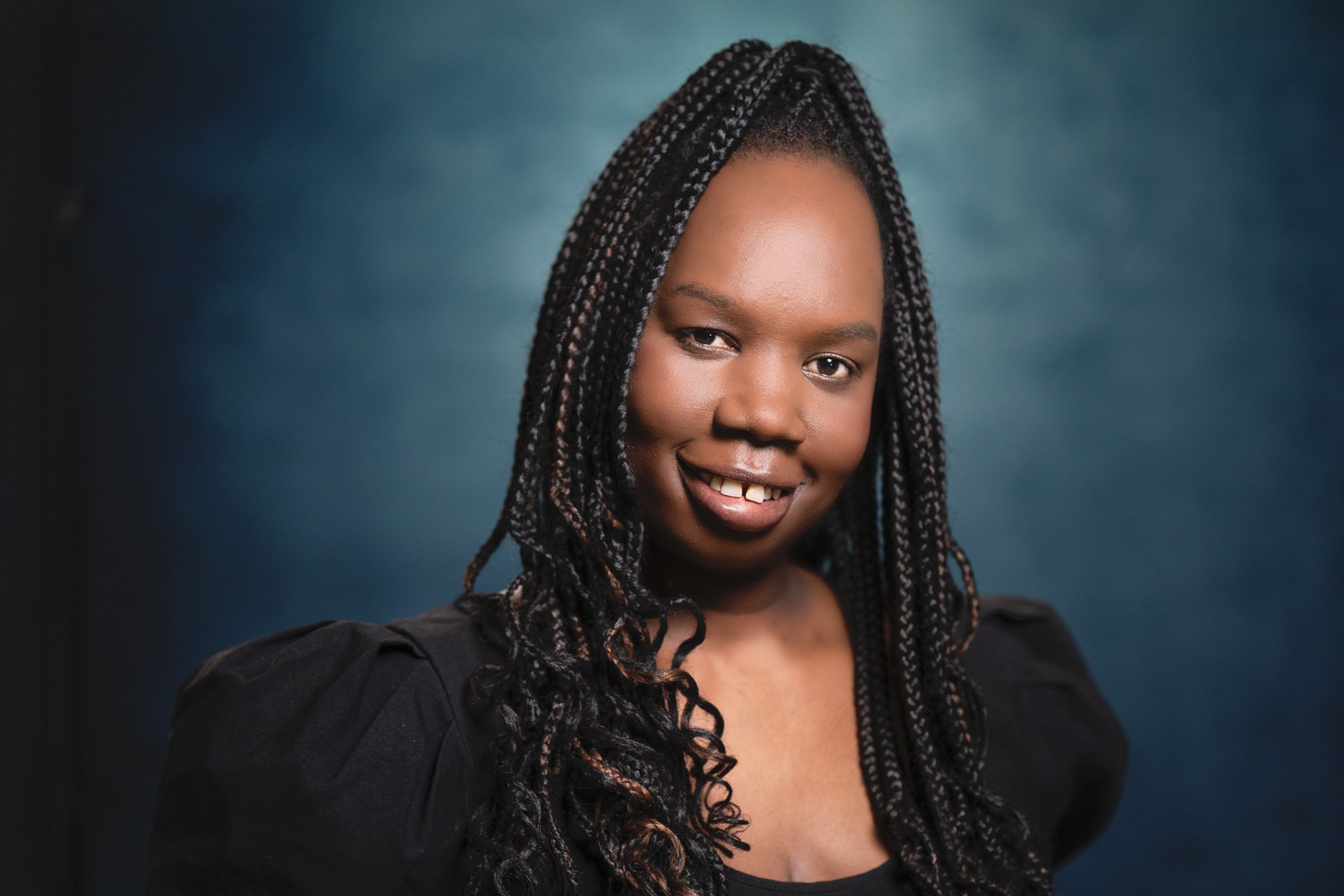
“I have been shaped by different continents and cultures,” says Elizabeth, who is from South Sudan. However, she grew up in Maine, on the east coast of the United States. She later moved from this peaceful place to Washington, DC, where she completed her university degree. “My upbringing in America has given me opportunities, an education and a strong sense of independence.” Yet Elizabeth’s roots have always remained deeply connected to South Sudan. That is where her parents come from.
Language and culture of South Sudan
“My father and mother come from two different ethnic groups in South Sudan, each of which speaks its own language. I love listening to my relatives on my mother’s side who speak Kakwa and to my father’s relatives who speak Nuer.” Elizabeth herself speaks English and Juba Arabic – a widely spoken language in South Sudan. “I think it’s important to speak my mother tongue and to teach it to my children. I want them to be able to communicate with relatives back home, understand their heritage and carry on that identity.”
As well as the language, the culture also keeps the connection with South Sudan alive, particularly the food. “South Sudanese food feels like an anchor and is authentic, something organic, not just in terms of the ingredients, but also in terms of its significance.”
She was therefore keen to seize the opportunity to become a senior adviser to the then Vice-President of South Sudan, Riek Machar Teny, and to move back to South Sudan. However, in 2013, conflict broke out in that country, leading the US to regard her presence there as a major risk, and she was evacuated. “That move became a major turning point in my life.”
Rotterdam: diversity, tranquillity and reserve
She met her South Sudanese-Dutch husband at an international conference. “That’s how my journey to the Netherlands began.” In January 2014, Elizabeth moved in with her husband in Rotterdam. “I immediately noticed the diversity; I was surprised that so many people speak English. The city didn’t feel overwhelmingly busy; life went on at a leisurely pace.”
It was a different way of life to what Elizabeth was used to in the US. “Compared to the United States, people here are a bit more reserved and value their privacy more. In America, openness and casual friendliness are very common. Here, it often takes longer to build relationships. People here also keep their work and private lives very carefully separate.”
A year after she arrived in Rotterdam, her first son was born. “Shortly afterwards, I set up my own consultancy firm. That was a major step because I was in a new country, whilst I was still adjusting to motherhood. It certainly required resilience, discipline and vision on my part.”
During the COVID-19 pandemic, Elizabeth was presented with an unexpected international opportunity. Based in the Netherlands, she was appointed Director for Africa at an American consultancy firm. “I connected regions through policy, development and strategic work. That way, I remained connected to the continent I come from.”
Making a positive difference in Rotterdam
So Elizabeth climbed the senior civil service ladder at a young age. “That’s why people sometimes have preconceptions about me. In my home country, leadership and responsibility are often associated with older generations and men. However, I gained experience and faced exceptional circumstances from a young age. That’s why I was able to take on these roles; it’s not just determined by age or gender.”
And her ambitions extend beyond her work. “I want to build a life in Rotterdam and make a positive difference to the city that has welcomed me. I want to help the residents look out for one another more and make this diverse city even stronger.”
Although she is a true Rotterdamer, she still feels a bit out of place from time to time; in other words, she misses having a home. “Still, I cherish hope for the future. For me, home is no longer just a single place on the map. It’s the place where I feel welcome and the bridge between where I come from and where I’m heading — between South Sudan, America and now the Netherlands. I hope that the next chapter of my life will be defined not by conflict, but by contributions and progress.”