
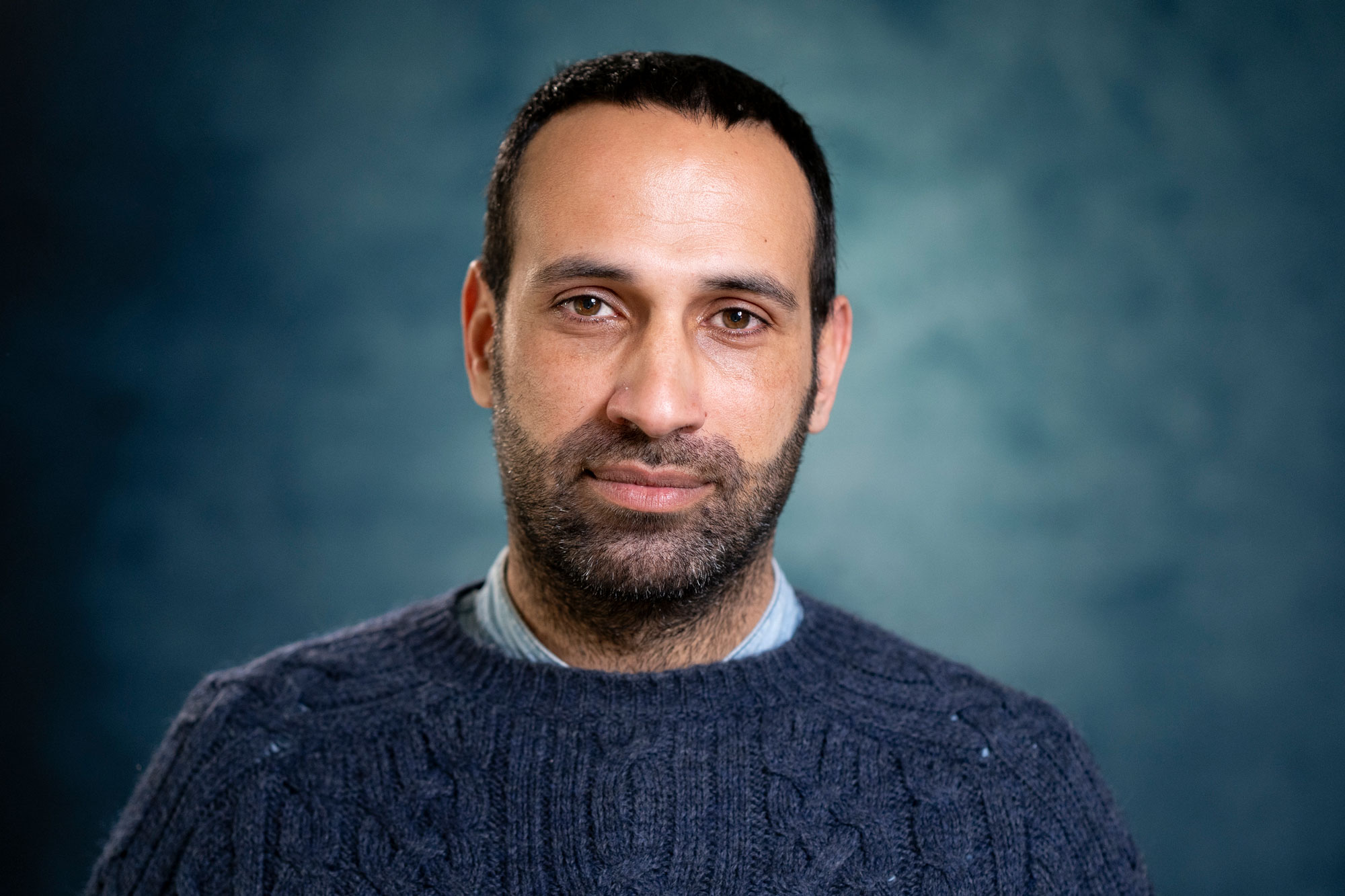
“My culture is based on sharing and interaction. Here, life is more individualistic,” says Ehab from the Palestinian territories. The Netherlands does not recognize these territories as the state of Palestine. That is why Ehab is considered stateless by the Netherlands. He lived in the West Bank, but regularly traveled to Europe for work. “In Palestine, you have to do tens of thousands of jobs to survive. But I always chose work that I was passionate about. So I was a political guide, filmmaker, clown, and trauma psychologist.”
As a political guide, he met a Moroccan-Dutch woman visiting with ten ladies from the Netherlands. “It started as a friendship and turned into love.” He left his beloved West Bank to get married in October 2023 at Rotterdam City Hall. He had never been to the city before. He had been to the Netherlands, though, in early 2020, before COVID-19. “That’s when I showed my short film ‘Survival’ here. I was only here for six days, but my first impression of the Netherlands was the high price of the train,” he laughs. “The country was also greener than I had imagined. And I noticed that the country had no mountains. I think it stood out because my country has many mountains.”
Individual and lonely
But in Rotterdam, he noticed greater differences between his homeland and here. In Palestine, we are a closed community. We have to be, because no one can easily enter the country. So it’s nice to see such a large number of nationalities and cultures here.” But Ehab is still unable to establish friendly contact with all these people. “Normally, I can easily mingle with people, but not here. For example, when I first arrived, I greeted people in the supermarket in Dutch. But I didn’t get a response. So now I’ve stopped greeting people or looking at them. I just put my earbuds in.” That’s a big difference from the culture in his home country. “My culture and customs are based on sharing and interaction. Here, life is more individual and lonely. So I have to change my mindset to survive here.” The lack of interaction is partly Dutch, but according to Ehab, it’s also really down to the city. “I feel freer in Amsterdam and Utrecht, where people let you be yourself. I also see more cultural events there.” The lack of contact makes him depressed. “Because people’s kindness is like water for plants. Without it, you’re dead.”
Paying taxes until the golden age
Ehab is now mainly trying to connect with people by learning our language. “Because language is not only a means of communication, it also reflects the culture. So the more you understand the language, the more you understand the culture.“ He is required to take integration classes, but it’s not easy. ”People underestimate me. They keep telling me that I have to pay taxes or that I shouldn’t hit my wife. I have to learn about the Golden Age, but I’m against it. It doesn’t motivate me to learn the language. And the language structure is overwhelming. So it feels like I have to restart my brain. But when I learn to understand the people around me, I feel more relaxed; then I know what they are talking about.
Palestinian food and songs
It helps Ehab to maintain Palestinian customs here. “I always cook Palestinian food. I also sing Palestinian songs.” He also finds a connection to his home at the market. “There are so many different people there, which also connects me to my country. Moreover, I can talk to the vendors there. I enjoy that more than scanning vegetables at a machine and going home.”
Still, it is difficult to think about his homeland from the Netherlands. “It’s hard to see your own people being slaughtered on TV and online while you feel safe. That makes you feel isolated. Because no matter how much you explain it, other people won’t understand your pain and fear.” Many residents of Rotterdam show solidarity with the situation in the Palestinian territories and express this openly. “I was really surprised by that. I found it quite positive. At the same time, I find it difficult to talk about it because people then look at you as a terrorist or a pathetic person. And in both cases, they forget that you are a human being. Don’t underestimate me because I am an Arab, but don’t cheer me on because I am Palestinian either. That way, I don’t feel free to wear the kufiya—a Palestinian scarf – because people stare at me.”
Heaven on earth
If he hadn’t met his wife, he would still be living in the West Bank. “Because every day is a learning experience, you learn something new every day, and you enjoy every day, regardless of the difficulties you encounter. There is always a solution, there are always people who will help. Palestine doesn’t just give you a place to live, it gives you an identity. You feel that in your soul before you think it in your brain. The place warms your heart even more than it warms your skin. I would call it heaven on earth.”
Bringing the film industry to the streets
Nevertheless, he plans to continue living in Rotterdam with his wife. But his dreams for the future extend beyond the city. “I want to start a film school that isn’t located in a specific place, but on the street. So that people can learn to make films in Palestine, Rotterdam, Morocco, and Italy. I want to change film culture from red carpet culture and thousands of hours of bureaucracy and funding to the street. Just like hip hop. It’s my dream that people learn to make films on the street instead of at school.”